‘Innovation is change that creates a new dimension of performance…the effort to create purposeful, focused change in an enterprise’s economic or social potential’ Peter Drucker – The Discipline of Innovation.
The focus on innovations within individual firms can not take place out of the context of complex motivations that drive firms to innovate. Within the Neo-classical framework the goal of the enterprise is to make profits whereas with an evolutionary approach the softer side of the equation is considered. ‘Messy’ issues such as politics and people are considered, and value networks and the impetus to innovate do not have to translate into profits immediately. A firm which focuses on product would seek a temporary monopoly and momentarily achieve an increase in profits whereas a firm which focuses on the manufacturing process may create a more efficient means of production for itself and reduce costs (Langowitz, 1991). The aim of this report is scan the external environmental forces of innovation as well as the innovation policies in place within firms and how they have effected the way management make decisions and influence the generation of new products and services. Are there a set of guidelines that management can use to better guide the innovation process and if so, are they homogenous to all industries and management styles?
Open Innovation
An Open Innovation Paradigm will be used to discuss the sources of innovation on a micro level.
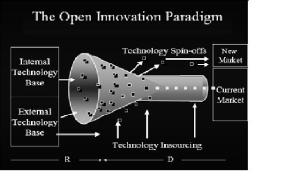
Fig 1. Source; Henry Chesbrough 2003
This variation on the traditional Pipeline Model (also labelled a closed innovation model) factors in the emerging need to collaborate outside the organisation and the growing trend of knowledge transfer from the “bottom-up” of the organisation; that is from entrepreneurship and intrapreneurship. This approach enables skilled labour to be more mobile and autonomous and requires management that can react well to the unexpected and spot (or have scouts or ‘innomediaries’ that can spot) emergent trends that can be absorbed or acquired from other organisations perceived as having something to offer.
In order to further leverage innovative capabilities within the firm, certain criteria can be put in place;
· Hire bright people
· Place them in conditioned environments away from market pressures
· Follow the pipeline model of selected ideas to products
· The product is delivered to the passive waiting customers
· The feedback cycle begins
In the above process value is derived from the transfer and transaction of knowledge which can be embedded in the new product development process using Nonaka’s Socialisation Externalisation Combination and Internalisation (SECI) Model as follows;
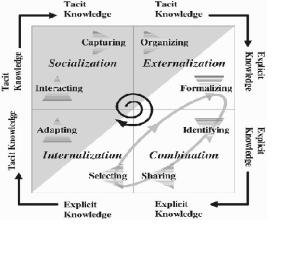
The procedures, competences, and the heuristics involved in the manifestation of the product from the internalised knowledge are specific to different industries, that is “each technological paradigm involves a specific technology of technological change” (Dosi, 1988)
External sourcing of innovation can be enacted by utilising partnerships (Intel, IBM and HP all collaborate on certain areas such the ‘Digital Business Ecosystem) or acquiring or merging with other companies. Remember innovation and R & D do not have to be a core competence! Lucent Technologies (who inherited the lion’s share of Bell laboratories) have devoted a vast amount of resources on the R & D of materials, components and systems. They searched for the fundamental discoveries that could fuel future generations of products and services. On the flip side, external sources as distributed knowledge connections, mergers and acquisitions can give a strategic direction to a firm taking part in the ‘innovation race’. Cisco developed this strategy to become an innovation leader (outperforming Lucent). Whatever technology that the company needed, it acquired form outside the organisation by either partnering or investing in promising start-ups (Henry W.Chesbrough, 2003).
Sources of Innovation
Drucker focused on areas of opportunity to innovate but fails to make a clear definition between internal & external sources of innovation (Drucker, 1998) and what the long term effect process innovations will have on the innovation process as a whole.
The sources of innovation really do vary case by case as innovation is an economic event. The most likely source of innovation is dependent on the likely distribution of innovation related rents (temporary profits) in the precise category of product, process or service being considered (Von Hippel, 1998).
The innovation process itself can be characterised in two ways;
- The creation of new knowledge through endogenous R & D efforts
- The ability to adopt existing technologies developed by others
(Hagedoorn & Duysters, 2002)
Endogenous Innovation
While innovation in firms used to take place in an ad-hoc on-demand fashion, firms are implementing more systematic robust methods. There has been an increased effort by firms to understand and identify the innovation activities underway in their firms.
“In the future, developing systems to support innovation and making the innovation visible will be increasingly important…prototyping an innovation methodology aimed at capturing creative ideas, business problems and enterprise needs.” (Curley, 2004)
Research and development (R & D) has become routinised and systematically pursued with the goal of seeking economic rents. A firm’s own R & D departments and knowledge stocks are the most blatant expression of internal innovations. Other avenues exist such as pursuing the “customer as innovator” approach eulogised by Thomke and Von Hippel. Certain companies have abandoned their efforts to understand exactly what products their customers want. Instead they have equipped them with the tools to design and develop their own products ranging from minor modifications to major new innovations. Techniques such as toolkits, computer simulation and rapid prototyping are utilised to manage the customer experience. IBM for example placed $40 million of in-house tools for developing software into the public domain to encourage people to write programs to run on Linux. This approach can prove to be difficult to implement as there may be a need to revamp business models and change management mind sets (Thomke, Von Hippel, 2002)
Dosi argues that the increasingly complexity of technology favours formal organisations (R & D laboratories, University Labs etc.) as opposed to individual innovators as the most conducive environment for innovation. This statement is backed up by the secular growth in the share of corporate as opposed to individual patents registered in Western economies (Dosi, 1988). However the level of technological complexity can inhibit adoption and the need to look at what customers are using can prove valuable. From a site visit to Microsoft earlier this year, the author was surprised to find that the more informal, less complex MS Communicator was the dominant form of transferring files, contacting each other, sharing calendars etc. internally, mirroring the way the general public communicates with each other.
Management has to be prepared, able and determined to take advantage of these systemic innovations to add value to the strategic business unit involved or even the organisation as a whole. Take as an example the approach adopted by Euan Semple, head of Knowledge Management for the BBC. When the BBC gave Semple the job, they expected him to spec out a big, expensive IT-based KM system (Weinberg, 2005).
His outlook however was tempered by the belief that the BBC is a network-based, conversational type of business. He decided to best approach was to go underneath the radar and let the BBC employees and users share the tacit knowledge they had built up over the years. This allowed the organisation to become a more innovative, agile organisation by “just letting people get together.”
Exogenous Innovation
When firms look to external sources they are looking at licensing raw ideas and technology and acquiring companies with market ready products. In assembling a balanced portfolio of open-innovation strategies, businesses are seeking help from a variety of innovation mediators (Nambisan & Sawhney, 2007). These ‘innomediaries’ can be classed as product scouts, electronic R & D marketplaces and patent brokers that help firms identify early stage ideas with potential. Another emerging source of innovation is ‘Innovation Capitalists’. They are companies often with a particular industry expertise that seek out and evaluate ideas and technologies from the inventor community. They develop and refine those ideas to the point where their market potential is validated and they then pitch them to large clients
Large companies seeking to work with Innovation Capitalists should forget the short term transactions they usually make with innomediaries and instead try to establish long term strategic partnerships with them – partnerships designed to improve the fuzzy front end of their own innovation processes as stated by Tom Cripe, Associated Director at Proctor and Gamble, “We want innovation capitalists to consider P & G as the preferred destination when they come across interesting ideas in the inventor community”.
By forming strategic alliances not just with Innovation Capitalists but also with other corporate parties, innovation activity can be combined and technology can be exchanged. These alliances can expect to have an impact on the long term product market combinations of the companies involved and are already widespread in high-technology industries Fig 2.

Fig 2. Source OECD
At the crossover point where internal and external technology meets, companies internalise knowledge capabilities that are somewhat exogenous to them and form strategic alliances. It is managements prerogative to deicide whether to form an alliance and disseminate knowledge in an open manner with partners (and rivals) or use mergers and acquisitions (M & A) to get the innovation capabilities they require.
For high-tech industries as show in fig.2 above an alliance might be more useful due to the quick expiration rate of knowledge and the speed of strategic response required. Timely learning from partners in the innovation process seems more appropriate that tight restrictions and control through formal organisations (Hagedoorn & Duysters, March 2002).
Mergers & Acquisitions refer to cases of joint activities, where two once separate companies are combined into one company. This combination also refers to the merging of two or more companies as well as acquisitions where one company maintains majority ownership over another company and their innovative capabilities. This approach is often dominant in low-technology industries where learning and flexibility are less important. There is little technological change and the rate of learning is of a lesser degree and a more structure control oriented approach is prevalent.
Managements Role
Management need to factor in all aspects of the innovation paradigm when making a decision on what directions and methods to pursue when pushing towards the bleeding edge of innovation. By using innovation capitalists and the customer/ end user, they are buying an innovation that is already at an advanced stage and validated to market. This lessens the importance placed on their own internal R & D and innovation capabilities and could be seen as a weakness by competitors.
There ability to find the right complement between external and internal sources of innovation and the agility to swap between them is key in the ‘innovation race’. The example of Dresdner Kleinwort Wasserstein (DrKW), a German Bank will highlight the role management plays in influencing the next generation of innovation products, services and processes. They adopted a forward looking approach to group collaboration, which included the use of Instant Messaging, Wikis, Blogs and boards. This project initially rolled out in the IS department and incrementally adopted in other business units thereafter. These communication tools act as innovation enablers by allowing for the informal transfer of tacit knowledge between staff which heightens the ability to create an enterprise wide value network.
It was hoped that this approach would lead to a snowball effect and organisational acceptance. However there was some resistance to this change as employees still considered email as the main form of communication even though studies by Thomas Davenport have shown that email is considered to overwhelm 21% and diminish productivity by 15% (McAfee, 2006).
Darren Lennard, the Managing Director of the London Office of DrKW, found similar issues with his mail (over 300 non relevant emails per day).He decided to take a top town approach and become the centre of the snowball. Lennard decided to post the agenda and action items for his meetings on a wiki and refused to read emails on some topics in the hope that his employees would realise that a wiki was a better tool for collaborative work. The internal blogging has increased by 400% in over a year and lead to drastic process improvements (Fig 3). Recently, Lennard wanted an analysis of how to double profits on a particular trade. Rather than send copies of the same document to several people via an e-mail attachment, only to have to keep track of, merge, and archive all the fixes back into a central version, he threw the problem up on a wiki page where everyone could brainstorm, comment, and edit in real time. In the space of two days, entire e-mail conversations evaporated and Lennard had analytics that would have otherwise taken two weeks. “Next year’s budget practically wrote itself on the wiki page” (Conlin, 2005)
Innovation is not a black art. When managers break from the status quo and stop thinking of innovation as the realm of the scientist and inventor and realise that it stems from various functional sources indigenous and exogenous to the firm, they can then find the best combination that will allow the firm to spawn the next generation of product, services and processes that will help the organisation to keep growing and competing in the innovation race.
References
|
Chesbrough, Henry. (2003) ‘The Era of Open Innovation’, MIT Sloan Management Review, Spring 2003, pp. 35-36
|
|
|
|
Curley, M. (2004) ‘Managing Information Technology for Business Value’, 1st Ed., Intel Press, Dublin, pp. 156
|
|
Digital Business, Financial Times, December 4th 2006.
|
|
Dosi, G. (1988) ‘Sources, Procedures, and Microeconomic Effects of Innovation’, Journal of Economic Literature Vol. 26, No. 3, pp. 1120-1171.
|
|
Drucker, Peter. (1998) ‘The Discipline of Innovation’, Harvard Business Review, November-December 1998, pp. 149-157
|
|
Duysters, G.; Hagedoorn, J. (2002) ‘External Sources of Innovative Capabilities: The Preference for Strategic Alliances or Mergers and Acquisitions’, Journal of Management Studies March, pp. 39
|
|
Langowitz, Nan S. (1991) ‘Motivations for Innovations in Firms: Economic insight into U.S. Competitive Stance’, Journal of Socio-Economics Vol.20 Issue 3, pp. 251-263
|
|
McAfee, A (2006), ‘MIT Sloan Mgmt Review: Enterprise 2.0: The Dawn of Emergent Collaboration’ Spring 2006, pp. 21 – 28
|
|
Nambisan, S; Sawhney, M (2007) ‘Meeting the Innovation Capitalist’ Harvard Business Review March 2007, pp. 24
|
|
Von Hippel, E. (1988), ‘The Sources of Innovation’, 1st Ed., Oxford Press
|
|
|
List of Figures
Fig 1
The Open Innovation Paradigm, Chesbrough, Henry. (2003) ‘The Era of Open Innovation’, MIT Sloan Management Review, Spring 2003, pp. 35-36
Fig 2
OECD Science & Technology Policy Division, Sheehan, J (2002), ‘Trends in Business R&D and Government Support for Business Innovation in OECD Countries’ Paris, 8 November 2002
Fig 3
McAfee, A (2006), ‘MIT Sloan Mgmt Review: Enterprise 2.0: The Dawn of Emergent Collaboration’ Spring 2006, pp. 28
 Ethan Cleary's Homepage