Introduction:
The European Union Commission defines a Small to Medium Enterprise (SME) as an enterprise that has fewer than 250 employees and which on its annual balance sheet does not exceed more than €43m. In Ireland, they account for 90% of organisations, of which 85% are seen as micro SMEs with less than 10 employees. As a result SMEs are recognised as a corner-stone of the European economy. However in reality, SMEs are in danger of losing competitiveness through globalisation & trailing ICT adoption. In regards to Ireland, they have a very strong ICT producing sector that performs extremely well when compared to other leading economies, both in terms of enterprise creation and attraction of FDI in the ICT and related sectors. Nevertheless, our performance is less impressive, however, when it comes to the adoption of ICT by existing enterprises in the non – ICT related sectors of the economy. So why should firms use ICT? They are encouraged to use ICT, but they are unclear of the benefit. Therefore any SME strategy should answer how can they achieve business transformation through IS?
Current research of ICT usage in SMEs:
Current reports and published articles from 2003 to 2006 have highlighted the gap between ICT and business processes and how this can be detrimental (security and disaster recovery) and retard SMEs ability to exploit the rich vein of opportunities available. The major findings of these reports showed almost half of the companies surveyed were classified as being under threat due to IT weaknesses such as security and disaster recovery. Another finding highlighted was the disparity between end user use of applications which rated highly and their technical ability in troubleshooting new problems that arose. Only 12% were generating business from their web presence and most were at a commerce plus or e-commerce stage of IT & Business level alignment. This fact highlights the state of ICT usage among SMEs in Ireland. Modern research outlines that SMEs do not review their business processes as a precursor to investment in ICT. This is due mainly to the fact that SMEs are operationally focused and in a niche market, therefore most feel that any change in a business strategy could undermine their core processes and hence threaten the viability of the business. (Levy & Powell, 2002)
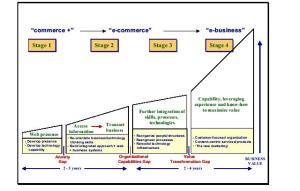
Figure 1: (Levy & Powell, 2002)
As from the model above, reports published and our own research, we see that over 70% of SMEs are at stage 1 of the model, utilising only brochure-ware. We propose an amendment to this model to include a stage 0 to document 20% of firms that have no web presence whatsoever and receive no benefits from ICT. Our own experience shows numerous micros SMEs in Ireland that are in Stage 0. From talking to the owner of a Roscommon based private coach hire service (2 full time and 6 part time employees) he deemed that ICT and a formal web presence was not vital to the continuing survival and success of his micro SME. Word of mouth and a community of practice approach was the standard business generating method and the owner felt that as his business was regionally based little was to be gained by utilising the Web and ICT. The ICT policies and strategies we will discuss, show how companies such as the Roscommon based SME could align their IT and Business strategies.
The current state of the majority of SMEs in Ireland is reflected in stage 1 & 2 of figure 1. The attributes of companies in stage 1 include basic web presence (brochureware) and IT capability such as hardware, peripherals and networking. Initially firms use basic Internet tools such as email and the Web. No online business transactions take place in stage 1. Managers and change agents at this level have no grounding in the skills and processes required to take advantage of ICT in their business strategy in order to bring them forward to stage 2 and upwards.
Stage 2 of the model, (the initial stage of e-commerce) involves building on the foundation of the skill sets and capabilities learnt from stage 1. Electronic business transactions and integrating ICT and business strategy are keys to moving to a defined e-commerce framework. ICT is used to gather basic customer information and help make strategic decisions on how to effectively market their product /services. The issues faced here are how to connect the front end and the back end of the enterprise. A quarter of companies placed in stage 2 have links between their online ordering and purchases, and their accounts receivable and payable processes and in turn 14% of these companies have links between their IT systems for managing the ordering and reordering systems(DETE, 2004). 26% of 96 companies surveyed in 2003 were using bespoke software from different vendors for different functional areas such as logistics, finance and sales, which can make integration seem like an albatross around the neck of the owner. (Enterprise Ireland, 2004).
Recommended Actions
In order to move from stage 2 upwards, a policy needs to be formulated from a recognised relevant government body. Parts of these schemes should involve international comparisons and collaborations to leverage other countries research and knowledge. For example England which is culturally close to Ireland, have 37.6 SMEs per 1000 people whereas Ireland has 24.6 in the same range (Financial Times, 2006) Research conducted by Shells LiveWIRE (British Youth Body) found that TAX breaks and Grants don’t necessarily work and have a low take up. They stress that extending enterprise education and not Tax relief was the forward. The British government have heeded this advice and started implementing plans to educate the SME population in ICT and other critical areas. For example Wales have designated £37million to target SMEs through a one on one advice programs. The Department of Enterprise, Trade and Employment have identified this gap and recommended Ireland adopts a similar approach. In a case study completed by Enterprise Ireland in 2003, consultants were sent to 96 companies and 95% felt that one day was proficient to identify the major issues facing their organisation. The key is to educate but the crux is to whom and what content do you educate?
Management need to be educated on high level ICT strategy and what’s available to them. It is not a necessity for them to manage the day to day running of the IT function? “Time spent managing IT is time not spent managing the business as IT is seen as an opportunity cost.”(Financial Times, 2006)
The necessary people skills, empathy and diplomacy are needed when talking to top level management about the alternatives to their existing (if any) ICT and sell the idea that ICT technical ability is not essential to implementing a successful ICT strategy. Firms such as Microsoft (MS Dynamic) and Intel (SuiteTwo) are aiming complete integrated ICT suites including WEB 2.0 technologies, to SMEs which will simplify the alignment process and reduce resistance to these change initiatives by working with existing mainstream software packages that are ubiquitous in SME environments. The fact that these services can be hosted off site cuts down the hardware expenditure and complexity, and allows the enterprises to concentrate on their core competences. For micro and level 0 SMEs it is possible to create a limited ICT infrastructure without any monetary investment; create a mail a/c with AOL that will supply domain name e.g. Tom@tom-motors.com. In order to communicate vertically and horizontally SKYPE can be utilised as an alternative to standard telecoms infrastructure.
Another approach that benefits SME in cost and regional networking is the Digital Business Ecosystem (DBE). The DBE is a free open source platform that is based on Internet technologies. It was developed by 20 EU partners such as SUN, IBM and Intel and Academic Institutions such as London School of Economics, University of Ulster and NUI Maynooth. It is designed specifically for SMEs to enable them to create, integrate and provide services more efficiently and effectively. It uses a peer to peer environment allowing you to connect to other SMEs to combine your product/ service with theirs and advertise all of these with other SMEs across the ecosystem. There is no fee and no more than basic IT knowledge is required to develop standard packages. This initiative is currently being road-tested in North Kildare and Meath to build up symbiotic mutually beneficial network of SMEs.
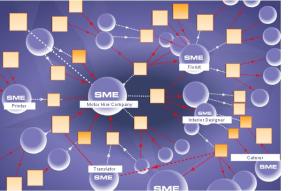
Figure 2 (http://www.digital-ecosystem.org/)
The diagram above is a graphical representation of how the DBE architecture operates, and how a SME could integrate it into its ICT strategy. As can be seen, an SME can join by means of a network, to other SMEs, their suppliers and possible customers, and therefore fully integrate their business processes with each other.
The above technologies and approaches are a possible way forward to align SMEs business strategies with ICT strategy and will keep Ireland in line with the Lisbon Agenda which aims to create a European Knowledge economy by 2010 and that our success in ICT adoption will match our success in ICT creation.
 Ethan Cleary's Homepage