
After a recent reunion with college buddies, we were sitting around the next day recovering from the night before. The TV was on but with no sound and three of the guys sat with laptops on each of their laps. One of them called me over to view the latest episode of Boardwalk Empire which was being streamed from an American ‘link site’. Maybe it was because I was standing back from the screen but I couldn’t help but notice how much advertising was present – maybe I needed that perspective to realise how immune I had become to ‘blatant banners’, pop-ups (don’t even realise I close them now) and even targeted advertising.
I remember using an adblocker for the first time. Initially I thought this was a great idea but then gradually stopped bothering to use the extension as I became as immune to generic web advertising as I did to traditional print and TV advertising. Then the onset of behavioural targeted ads initially intrigued me – as the ads seemed to be magically linked to my thoughts at the time, but gradually that faded away and I don’t notice the targeted adds in my gmail or facebook anymore. It’s not just digital advertising that gets filtered out.
It’s very rare that I can remember specifics about television adverts – is it me or do all car ads blur into one? I couldn’t remember if ‘Va Va Voom’ was Peugeot or Renault. One brand that has stuck with me was Levi Jeans. They commissioned TV adverts that were very stylised and used classic tunes that were hook-heavy (‘Heard it through the Grapevine’, ‘The Joker’) and that became part of their appeal, well up until Shaggy anyway.
More on the classic Levi ads here
What does work for me? Why do I buy stuff? I actively search for items I need at the time or I read a review by somebody who’s opinion I rate. For film and music this used to be the likes Allan Jones/Uncut Magazine, Empire Magazine etc. This has been replaced due to time constraints, by deferring to my friends and peers. I will see what @johnstapo is currently listening to on spotify or what music links he places on facebook and that for me is all the recommendation I need – more often than not I will convert. From a professional point of view, I use LinkedIn Groups, Twitter and even Facebook to deliver updated information on my avenues of interest.
We have seen traditional marketeers trying to pick out these influencer’s and employ an interactive endorsement technique, but this can backfire as Brian O’Driscoll found out with his unabashed tweets about how great Gillette blades are.
 One area where this approach appears to work is tobacco. Back in the mid 90’s, with most marketing channels blocked by legislation, Camel cigarettes decided to give free ciggies to the bands du jour in order to try and pick up the teenage ‘idolation dollar’.
Another approach used by big tobacco is to focus on placement in TV Series and Movies. Look at shows like Mad Men where one whole episode is dedicated to Lucky Strike, with the tobacco giant being integral to the plot (along with other tobacco brands) throughout the 4 series.
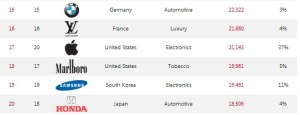
Check out where Marlboro ranked in the ‘Best Global Brands 2010’.
I recently deleted my Facebook account about 6 months ago to remove all the ‘noise’ I had collected there. I recreated my page and only re-added people that I interact with on a frequent basis. I also re-added info sources that I found useful. The result is that I have about 50 friends and 12 regular feeds. Interestingly enough Path which is labeling itself ‘the personal network’ (and involves a certain Sean Parker from Napster and Facebook fame) limits you to 50 connections. It chose the 50 number based on the theories of Oxford professor of evolutionary psychology Robin Dunbar, who claims that 150 is the maximum number of social relationships any human can handle.
So how do marketeers plan to access these personal networks and how can they effectively target an ‘ostrich’ like me. I came across Empire Avenue whilst researching this article. Their pitch is “Imagine that people are companies whose product is the valuable content they write, create and post on the internet on sites likeFacebook, Twitter, Flickr and their blogs. On the ‘influence stock exchange’ on Empire Avenue you can buy virtual shares in individuals with free virtual currency and profit from their success and content”. So can companies look at investing ‘Social Capital’ into influencers whose interests are aligned with their brand/business. Does that also open up the possibility of firms spread betting and punting against people’s social capital value?
I’ll finish up with 2 items;
Can you name the companies attached to the ‘Top 10 Taglines of the Last Century’. Just highlight to reveal the answers.
1. Got milk? (1993) California Milk Processor Board
2. Don’t leave home without it. (1975) American Express
3. Just do it. (1988) Nike
4. Where’s the beef? (1984) Wendy’s
5. You’re in good hands with Allstate. (1956) Allstate Insurance
6. Think different. (1998) Apple Computer
7. We try harder. (1962) Avis
8. Tastes great, less filling. (1974) Miller Lite
9. Melts in your mouth, not in your hands. (1954) M&M Candies
10. Takes a licking and keeps on ticking. (1956) Timex
 Ethan Cleary's Homepage